
Have you ever wondered how your smartphone acknowledges your voice, or how the net shows you precisely the outcomes you’re searching for the moment you seek? All of this is made possible via a silent hero—the algorithm. It’s not a complicated component but a fixed set of step-via-step instructions designed to solve troubles, just like a recipe.
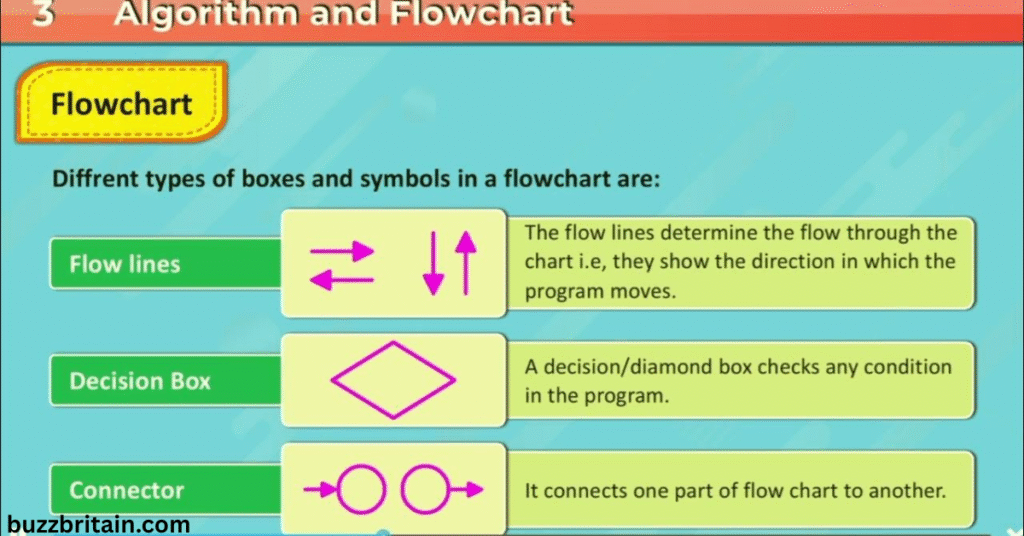
consider this: you want to get to a new location in a large metropolis without a map. What would you do? the first step: ask for directions. Step 2 : observe the signs and symptoms. Step 3: stop whilst you attain your destination. That’s basically a set of rules! It is about breaking down any complex problem into smaller, achievable steps and then executing them in series to gain the ideal result.
Nowadays, each cog in our virtual global is pushed via algorithms. Whether it’s curating the content to your social media feed or diagnosing an infection in a clinic, this invisible logic is operating backstage to make our lives simpler and more green. allow’s exploration in the desk under how algorithms feature across one-of-a-kind fields.
| Field | Role of the Algorithm | Everyday Example |
| Search Engines | Ranking web pages | Searching for “best recipes” on Google |
| Social Media | Curating content | Interesting posts in your Facebook News Feed |
| E-Commerce | Recommending products | “Recommended for you” section on Amazon |
| Banking | Detecting fraud | Alerts for unusual credit card transactions |
| Transportation | Finding the best route | Fastest route on Google Maps |
Set of rules Definition and fundamental concept
A set of rules is a systematic system in laptop science and mathematics for fixing issues. It’s miles from a set of clean, finite, and logical instructions designed to carry out a particular challenge. The success of any algorithm depends on its correctness, efficiency, and guarantee of reaching an endpoint.
Each set of rules possesses three key traits: a clear start and quit factor, step-by-means-of-step commands, and practical feasibility. It could be written in any language, whether in undeniable English sentences or traces of code. As an instance, a simple algorithm to kind a list of numbers is very simple.
Step one is to examine the first and 2d numbers inside the listing. The second step is to switch their positions if they’re inside the incorrect order. The 1/3 step is to repeat this procedure for the following pair of numbers. This keeps till the complete listing is in ascending order. That is called the “Bubble kind” set of rules.
How Do Algorithms Paint? Key elements
The construction of an effective algorithm depends on numerous key elements. Those factors ensure the set of rules operates truly, fast, and appropriately. They include enter, manner, output, finiteness, and effectiveness.
Input: This is the data or facts on which the set of rules operates. For instance, the keywords typed right into a seek engine.
Procedure: All the logical and mathematical steps through which the enter is converted.
Output: The very last result or solution the algorithm gives, which includes a list of search effects.
Finiteness: An algorithm wants to terminate after a finite wide variety of steps as an opportunity of getting stuck in an infinite loop.
Effectiveness: Each step needs to be practical and actionable, leading to a clear outcome.
Correctness: The potential to provide an accurate result in all cases is paramount.
Crucial types of Algorithms and Examples
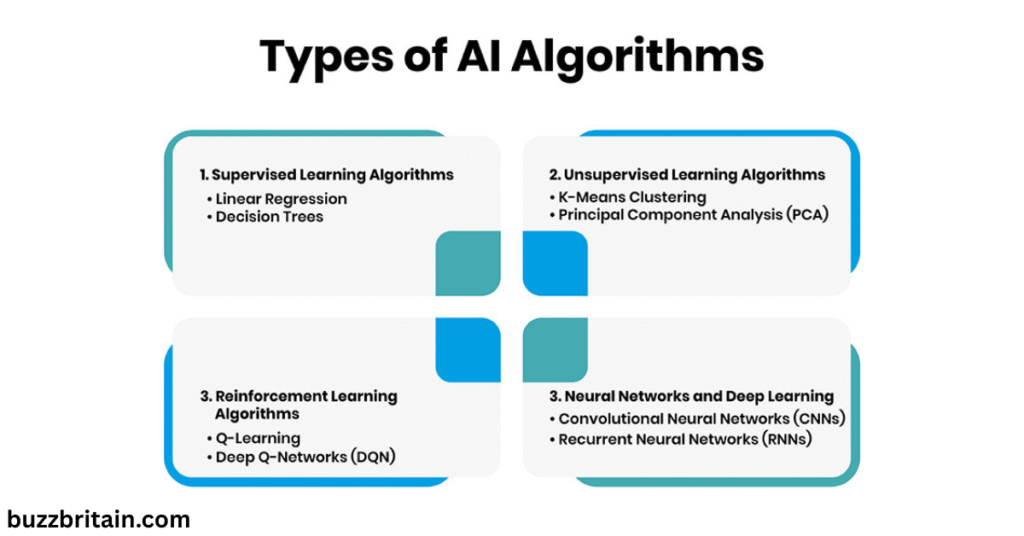
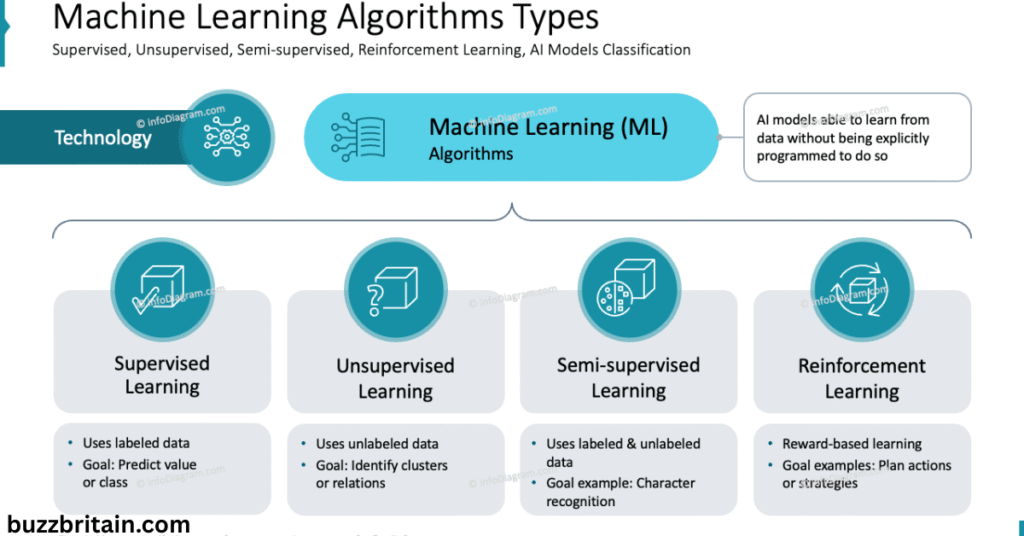
Algorithms are labeled into different sorts primarily based on their layout method and purpose. Every kind is appropriate for solving unique types of problems. A few essential types are listed under.
1. Sequential Algorithms:
These run in a truthful, linear style in which one step starts off evolved handiest after the previous one is whole. Most basic operations, like calculations, fall into this class.
2. Divide and triumph over:
This algorithm breaks a huge hassle down into smaller sub-problems. Each sub-problem is solved independently, after which all solutions are blended to form the final result. “Merge sort” is a high example.
3. Greedy Algorithms:
Those algorithms make the choice that seems great at each instant step. They don’t continually yield the globally foremost final end result but are regularly speedy. The “coin trade” hassle is commonly solved this way.
4. Dynamic Programming:
That is a technique for fixing complex issues wherein the trouble includes overlapping sub-issues. It stores the result of each sub-hassle to avoid recomputing it in more than one instance. finding the shortest direction in a GPS is a not unusual utility.
The importance of Algorithms in normal life
Our internationals these days might be absolutely special with our algorithms. They decorate our performance to superb levels and resources in choice-making across each quarter.
Inside the medical field, algorithms can analyze MRI and X-ray images to discover sicknesses like cancer at early degrees. In finance, they examine market styles and strengthen algorithmic buying and selling.
In transportation, apps like Uber and Careem examine visitors’ facts to determine the high-quality path and pricing. In leisure, the advice structures on Netflix and YouTube are also powered through complex algorithms that understand your pastimes.
Frequently requested Questions (FAQs)
Q: Are a set of rules and code the identical aspect?
No. A set of rules is the logical plan or blueprint for solving a trouble, that could even be sketched on paper. Code is the precise language (like Python or Java) wherein this plan is written in order that a pc can recognize and execute it.
Q: Can algorithms be biased?
yes. Algorithms are created by using humans and depend on information. If the underlying statistics consist of bias, the set of rules’ outputs also can end up biased, as visible in some hiring or loan approval structures.
Q: Where do I need to begin to study algorithms?
To start, logical thinking and a basic understanding of arithmetic are crucial. Then, you could begin with publications on “records structures and Algorithms” (DSA). unfastened introductory material is to be had on line structures like Coursera, edX, and Khan Academy.
Conclusion
Algorithms are the spine of the modern era. They no longer best shape laptop technological know-how however also have an effect on our day by day decisions. knowledge of their essential kinds and the way they paint is a crucial talent within the virtual age.
Nowadays, you learn what an algorithm is, how it works, and its different types. You may now construct upon this information. In case you are inside the tech discipline, learn how to put in force algorithms in a specific programming language.
